Free Service
Stop guessing your recovery path. Click the button below to text our team directly on WhatsApp. Attach your latest ultrasound or lab reports, and get a private, 15-minute clinical evaluation directly from BHU Research Scholar Shringarika Mishra.
The PCOS Paradox: Why Hardcore Gym Workouts Lock Your Weight
To understand why standard cardio and heavy physical training fail to reduce weight in a PCOS lifestyle, we have to look closely at two major internal factors: Hyperinsulinemia (chronically high floating insulin) and Adrenal Hypersensitivity.
In a standard, healthy metabolic system, jumping on a treadmill or performing intense crossfit exercises forces your body to tap into stored fat reserves for clean fuel. However, when a woman dealing with metabolic imbalances pushes her heart rate into an extreme anaerobic zone, her brain interprets that rapid physical stress as an immediate threat to survival. To protect you from what it senses is an external crisis, your adrenal pathways release a massive surge of a stress messenger called cortisol.
For a standard body, this cortisol burst is temporary. But for a PCOS framework, high circulating cortisol acts like a direct physical command to your liver to release extra sugar into your bloodstream, which triggers a secondary spike in insulin. Because insulin is your body's master fat-storage hormone, having it constantly active blocks your cells from burning stored tissue. Instead, it forces your body to pull floating nutrients and deposit them directly as deep visceral fat around your midsection, while leaving you feeling intensely hungry and absolutely depleted of physical energy.
The Real Solution: Activating Your Calm Pathways
Losing weight when managing PCOS is fundamentally a hormonal synchronization challenge, not a basic calorie counting problem. At Sir Sunderlal Hospital (BHU), our clinical observations demonstrate that you must prioritize Vagal Tone Stimulation to shift your autonomic nervous system completely away from a defensive emergency state and straight into a calm, restorative framework. When your brain recognizes that your physical structure is fully supported and entirely relaxed, your baseline cortisol production drops immediately. This systemic reduction lowers your circulating insulin needs, unlocks your fat pathways safely, and allows your internal systems to process food energy efficiently without causing joint stress or adrenal exhaustion.
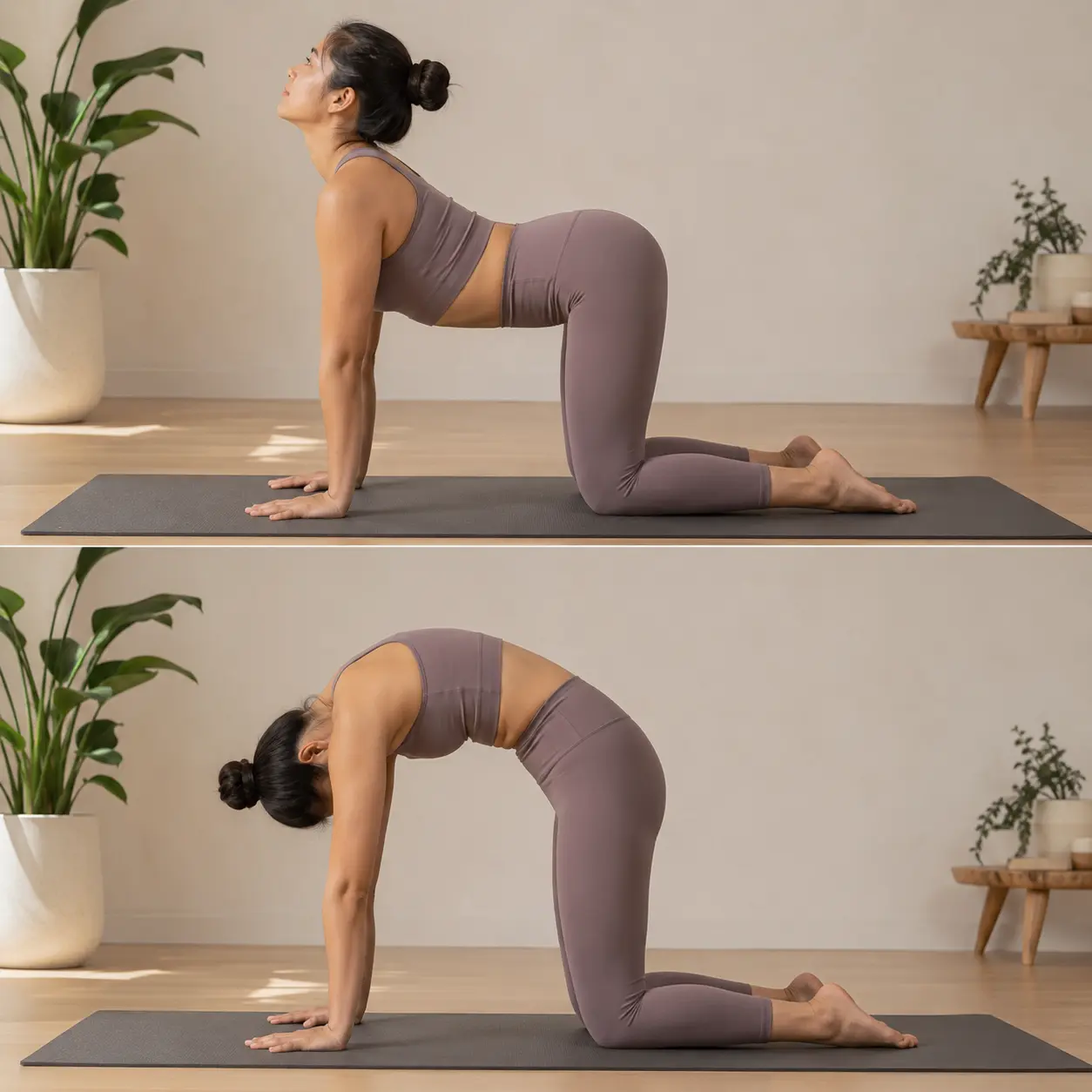
The Core Specialized Routine for Safe Metabolic Alignment
Our specialized clinical methods at onlineyogaclass.in rely on a low-impact, highly structured workflow. We use deliberate holds and soft alignments to talk directly to your master endocrine glands, boosting your basal metabolic rate (BMR) naturally.
1. Supported Reclined Butterfly Pose (Supta Baddha Konasana)
Duration: Practice this hold quietly for 10 to 12 minutes every evening or right before sleep.
How to practice: Sit comfortably on your mat or bed. Slowly lower your spine flat down until your back is resting completely against the floor. Bring the bottom pads of your feet together to touch, and let your knees gently drop wide open toward the left and right sides. Slide thick bed pillows or rolled blankets right under your outer thighs. This support is absolutely vital so your lower abdomen and inner groin do not experience any pulling or muscular strain. Rest your hands softly over your lower stomach, close your eyes, and allow your body to become completely heavy.
The Biological Response: This supported posture completely removes weight and tension from your pelvic floor. It tells your adrenal glands to stop releasing emergency stress messengers, uncoils tight internal tissues, and helps clear out fluid accumulation and stagnation around your ovarian pathways.
2. Isometric Core Stabilization (Phalakasana Variation)
Duration: Hold steadily for 30 to 45 seconds, repeating 3 times every morning.
How to practice: Come forward onto your hands and knees on your mat. Place your forearms flat against the floor directly beneath your shoulders, keeping your elbows aligned. Extend your legs straight back behind you, tucking your toes under, and lift your knees to create a long, straight line from your heels up to the crown of your head. Instead of pulling your stomach in forcefully or doing rapid crunches, focus on drawing your lower belly up smoothly and tightening your thigh muscles. Keep your breathing slow, deep, and steady.
The Biological Response: Rapid, aggressive abdominal crunches increase pressure within your stomach cavity, which can worsen pelvic tension. This gentle, steady isometric hold builds lean muscle mass safely, boosting your insulin receptor sites without overworking your delicate adrenal system.
3. Post-Meal Thunderbolt Posture (Vajrasana)
Duration: Hold for 5 minutes immediately within 10 minutes of finishing your main meals.
How to practice: Find a soft mat or carpeted floor. Kneel down on both knees. Bring your big toes together behind you so they touch, and spread your heels out wide to the sides, creating a comfortable space to sit your seat down directly between your feet. Keep your spine long and straight, roll your chest open, and rest your palms flat on your thighs. Look straight ahead and breathe naturally, allowing your belly to rise and fall softly.
The Biological Response: Kneeling in Vajrasana alters the blood circulation paths in your lower body, temporarily redirecting a warm wave of blood flow away from your legs and straight into your digestive organs. This steps up your digestive fire, eliminates post-meal bloating, and assists your body in processing and clearing out glucose from your meal.
4. Supported Legs-Up-The-Wall Posture (Viparita Karani)
Duration: Sit and hold for 10 minutes every evening when you feel physically or mentally fatigued.
How to practice: Place your yoga mat or a soft blanket directly up against an open wall. Sit sideways with one hip pressing against the wall. In one gentle, fluid movement, lower your upper back flat down onto the floor while swinging your legs straight up against the wall. Your body will form a comfortable L-shape. Slide a soft pillow or folded blanket directly under your lower back and hips to keep your pelvis slightly elevated. Relax your arms out to your sides with your palms facing upward, and let all the tension drain from your thighs.
The Biological Response: This posture reverses the daily effects of gravity on your circulatory system. It assists stagnant fluids in draining safely back out of your lower limbs, relieves pelvic congestion, and guides your brain into a state of deep cellular restoration.

Holistic Integration: Aligning Your Habits with Natural Rhythms
Reversing a stubborn weight plateau when managing complex metabolic syndromes requires looking beyond just physical exercise. In our structured clinical programs, we closely integrate ancient lifestyle guidelines—known as Dinacharya—to help synchronize your daily habits with your internal biological clock.
This comprehensive framework includes practicing mindful timing with your food choices, ensuring you consume your largest meal of the day when your digestive energy is naturally performing at its peak. We also guide you in introducing soothing daily rituals, like dedicated evening breathing habits, to help clear away the mental and physical stress built up from modern demands. This intentional combination prevents sudden, unwanted insulin variations throughout the day and guides your system into a state of long-term wellness.
Why Informed, Evidence-Based Guidance is Vital
Generic fitness programs or standard public exercise videos are very often either too aggressive and exhausting, or entirely too passive to trigger a true structural recovery for a woman with PCOS. Our research-backed methodology, proven through 16 published scientific papers, looks at every gentle posture and breath adjustment as a direct, purposeful biological intervention.
We do not ask you to fight your body or push it into complete exhaustion. By using a supportive, clear language of soft movement, we help you lower your insulin dependency, soothe your internal nervous pathways, and reclaim your natural, vibrant baseline of health and long-term energy.

About Shringarika Mishra
Gold Medalist (University of Patanjali) & NET JRF (AIR 2). Research Scholar at Banaras Hindu University (BHU) specializing in Clinical Yoga and Neuro-Metabolic Integration. With over 11 years of active research experience and 16 published scientific papers, she provides evidence-based biological healing through onlineyogaclass.in.
Medical Disclaimer: The clinical research findings and lifestyle protocols shared in this article are intended entirely for general educational and health-awareness purposes, drawing on physiological systems analyzed during my clinical research at BHU. This content cannot replace professional medical diagnosis, specialized metabolic blood panels, or medical endocrinology oversight. If you experience unexpected extreme rapid weight shifts, severe clinical depression, or severe abdominal pain, please consult a medical physician immediately.