Deconstructing the Terms: Arterial Elasticity vs. Systemic Resistance
To approach your cardiovascular recovery safely, we must clarify the hidden feedback loops that link your survival nervous networks directly to your peripheral vascular walls. Arterial tension is never a fixed mechanical value; it responds dynamically to the autonomic signaling patterns traveling down from your brainstem.
| Cardiovascular Parameter |
What Happens Inside the Micro-Environment |
The Direct Impact on Your Long-Term Readings |
| Baroreceptor Reflex Calibration |
Specialized stretch receptors within the carotid sinus that monitor real-time arterial pressure variations. |
Become desensitized by chronic stress loops, causing the heart to overcompensate by maintaining a permanent pressure spike. |
| Peripheral Vasoconstriction |
The automatic tightening of the muscular layer wrapping around your capillary loops during stress alerts. |
Forces your heart to pump much harder against high systemic resistance, reducing vascular tissue elasticity over time. |
| The Vagal Brake Mechanism |
The parasympathetic neural switch that commands your heart rate to slow down and dilates tight artery channels. |
Can be manually engaged through specific somatic alignments to naturally drop blood pressure parameters safely. |
According to detailed international directives compiled by the World Health Organization (WHO), chronic high blood pressure remains a leading driver of global cardiovascular mortality and vascular wear. When your life is dominated by constant rushing, executive pressures, and shallow chest breathing patterns, your body enters a continuous Sympathetic Surge. This state forces your deep arteries to contract, trapping metabolic waste products, or Ama, within your vital organ structures. Our Varanasi clinical yoga programs resolve this imbalance through targeted Neural Recovery—gently training your blood vessels to regain their natural flexibility without depending on aggressive physical exertions.
The Science Lesson: Baroreceptor Desensitization and Core Vascular Hemodynamics
Let us break down the exact biological mechanism that links your physical alignment and breathing to your arterial pressure baseline. Your cardiovascular system is not an isolated mechanical pump; it operates in constant communication with your brain stem. Every time your heart contracts, it relies on real-time feedback from your baroreceptors to adjust its pumping speed and keep your circulation balanced.
When your body remains locked in a protective stress position—characterized by a rigid chest, tight neck columns, and shallow diaphragmatic movements—your pressure sensors lose their natural sensitivity. This neural desensitization causes your brain to believe your internal organs are starving for blood, triggering an automated demand for a sudden pressure increase. This response keeps your arteries in a tight, narrow state, accelerating metabolic fatigue across your tissues.

Our somatic method bypasses this cycle through Biological Scaling. By utilizing slow, supported movements that alter internal pressures, we gently train your arterial walls to expand. This process reopens restricted capillary networks, helps clear old Ama from your circulation channels, and balances your thyroid-ovarian axis to support smooth metabolic flow. These precise adjustments engage your master Vagal Brake, signaling your brain to lower systemic resistance and restore a natural, healthy circulatory rhythm without placing any mechanical strain on your body.
The Diaphragmatic Pressure Switch
Did you know that taking deep, slow abdominal expansion breaths can lower your systolic blood pressure metrics by up to 10 points within minutes? In physiological tracking sessions, when a practitioner extends their exhalation phase, they apply direct mechanical stimulation to the vagus nerve trunk passing through the chest. This mechanical compression signals your motor cortex to lower its alert signaling, reduces circulating adrenaline levels, and clears the metabolic waste that stiffens vascular walls. This demonstrates that you can use targeted physical breathing signals to manually control your heart's workload safely.
The Somatic Protocol: Three Core Sequences for Vascular Reset
To safely scale your arterial flexibility and clear out long-held systemic resistance patterns, practice this precise clinical sequence daily:
1. Resonant Cardiovascular Coherence Breathing Loop
Time to Practice: Practice this calming breathing rhythm for 5 to 7 minutes every morning before starting your work routine.
Execution Guidelines: Sit up nice and tall in a comfortable cross-legged position, using a firm cushion under your hips to keep your spine effortlessly straight. Let your shoulders drop away from your ears, and rest your hands flat on your knees. Close your mouth softly and look forward. Take a slow, quiet inhalation through your nose for a strict count of 4 seconds, allowing your lower abdomen to expand outwards. Then, without holding, exhale smoothly and quietly through your nose for a count of 6 seconds. Maintain this steady, rhythmic pattern, focusing your mind entirely on the smooth transition between breaths.
Why it works: Extending your exhalation works like a direct mechanical brake on your overactive stress networks, lowering the sympathetic nerve signals that tighten your blood vessels. This specific 5-to-6 breaths-per-minute rhythm improves your heart rate variability parameters, supporting long-term cardiovascular resilience and protecting your cells from pressure spikes.
2. Supported Legs-Up-The-Wall Inversion (Viparita Karani)
Time to Hold: Rest quietly in this passive position for 10 minutes at the end of your evening activities.
Execution Guidelines: Position your yoga mat or a soft blanket flat against an open wall space. Sit sideways with your hip pressing directly against the baseboard, and in one smooth, unhurried motion, lower your back down flat onto the floor while swinging both legs straight up the wall. Slide a soft pillow or folded blanket directly underneath your lower back and pelvis to keep them comfortably supported. Let your arms open wide away from your sides with your palms turned up toward the ceiling, and completely relax your leg muscles.
Why it works: This gentle inversion reverses the everyday pull of gravity on your circulatory system. By assisting pooled, stagnant blood in traveling effortlessly back toward your central heart chambers, it clears lower body vascular pooling, lowers your resting heart rate, and signals your nervous system to enter a deep state of restoration.
3. Vertical Calibration Posture (Tadasana)
Time to Hold: Maintain this standing alignment for 2 minutes every morning after completing your breathing practice.
Execution Guidelines: Stand up tall on your mat with your big toes touching and your heels slightly apart. Distribute your body weight evenly across both feet, anchoring into the tripod points of your soles—the big toe ball, the little toe ball, and the center of your heel. Engage your thigh muscles gently to lift your kneecaps, lengthen your spine upward, and let your arms rest relaxed along your sides with your palms turned forward. Keep your shoulders soft, look straight ahead at a single unmoving spot on the horizon, and breathe naturally.
Why it works: This precise vertical structural alignment helps recalibrate Baroreceptor Sensitivity inside your carotid sinus. Maintaining a steady, unhurried horizon gaze helps turn off your body's defensive alert reflexes, helping your blood vessels relax and supporting natural pressure regulation safely.
FREE SERVICE
Get a Free Cardiovascular & Blood Pressure Analysis
Stop letting fluctuating readings fuel your daily anxiety. Click below to message our care team directly on WhatsApp. Share your recent blood pressure charts, health timelines, or medical records, and receive a private 15-minute diagnostic evaluation directly from BHU Research Scholar Shringarika Mishra.
UPLOAD YOUR CIRCULATORY REPORTS NOW
Why 'Clinical' Precision Trumps Aggressive Cardiovascular Exercise
As a Gold Medalist (University of Patanjali) and Research Scholar at BHU, I firmly advocate that high blood pressure management must be handled through careful, gradual transitions. When your circulatory channels are already under a state of baseline tension, forcing your body through high-intensity cardio, heavy sweating routines, or rapid, exhausting exercises can be highly counterproductive. Your heart does not see intense training as a recovery boost; it decodes the sudden muscular demand as an emergency, spiking your sympathetic output and tightening your arterial walls further.
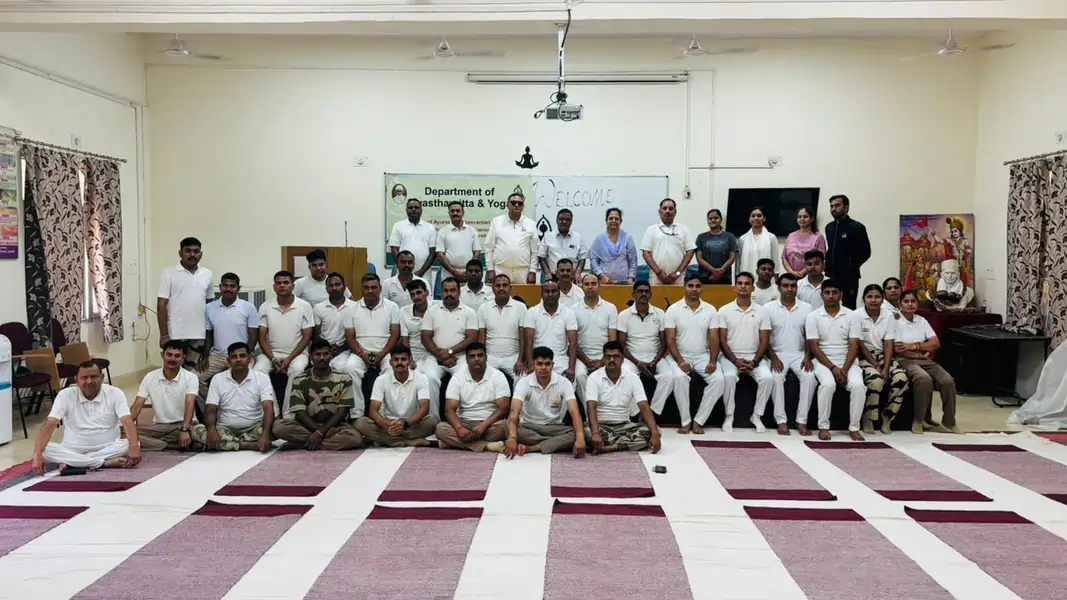
Our specialized heart health batch programs at onlineyogaclass.in treat your circulatory network as a responsive bio-network rather than a simple mechanical pump. By replacing high-impact exercises with mindful, prop-assisted configurations, we turn off your body's automated threat switches safely. This tailored approach ensures your internal pathways stay entirely open, leaving you feeling calm, light, and completely re-anchored in your natural strength.

About Shringarika Mishra
Gold Medalist (University of Patanjali) & NET JRF (AIR 2). Research Scholar at Banaras Hindu University (BHU) specializing in Clinical Yoga and Cardiovascular Health Protocols. With over 11 years of experience and 16 published research papers, she provides evidence-based biological healing through onlineyogaclass.in.
Medical Disclaimer: The clinical insights and research-based observations shared in this article are intended entirely for general educational and health awareness purposes, drawing upon baseline neurobiological pathways evaluated during my clinical research work at BHU. This content can never replace professional medical diagnosis, specialized laboratory profiling, or direct cardiology care. Always consult with your physician before beginning any new clinical yoga protocol.